In this article, let’s use light poles as our case in point. They are structural, safety-critical, and produced from tightly controlled alloys. One of the questions I hear repeatedly in lighting-column projects is: how much recycled aluminium can we realistically use?
I understand why the question comes up so often. Recycled content is easy to recognize as a sustainability measure, and aluminium has a strong story here. It can be remelted again and again without losing its essential properties, and recycling it typically requires only a fraction of the energy needed to produce primary aluminium.
But in my day-to-day work, the answer is rarely a simple percentage.
The recycling value chain is not that easy to understand.
I manage recycling streams and work closely with the quality requirements behind extruded aluminium for light poles. That means I spend a lot of time looking at what is technically possible, not just what sounds good in a specification or procurement document. And when it comes to light poles, the difference between those two things matters.

The idea of 100% recycled aluminium is attractive. In some situations, it is technically possible. But it is not something I would describe as common. The real answer depends on alloy chemistry, product requirements, and the quality of the scrap available to us.
Where the real limits appear
In my experience, recycled content in light poles is shaped by two connected realities.
The first is the performance the light pole must deliver. The second is the material we have available to make that happen.
Light poles are not generic aluminium products. They need to meet clear requirements for strength, formability, corrosion resistance, and often passive safety. In Europe, those expectations are typically linked to standards such as EN 40-6, EN 12767, and EN 12899. That usually leads us toward 6000-series alloys like 6005A, 6060, 6063, or 6082.
Those alloys are well suited to the application, but they also come with tightly defined composition limits. Elements such as magnesium, silicon, iron, copper, and manganese all need to stay within a specified range. Once you start working with recycled input, that is where things become more complex.
Scrap is valuable, but it is rarely simple
People sometimes talk about recycled aluminium as if it were one uniform raw material. It is not.
The scrap we use can come from very different sources. Some of it is pre-consumer scrap, generated during production and fabrication. This material is often clean, well understood, and easier to reintroduce into a controlled loop.
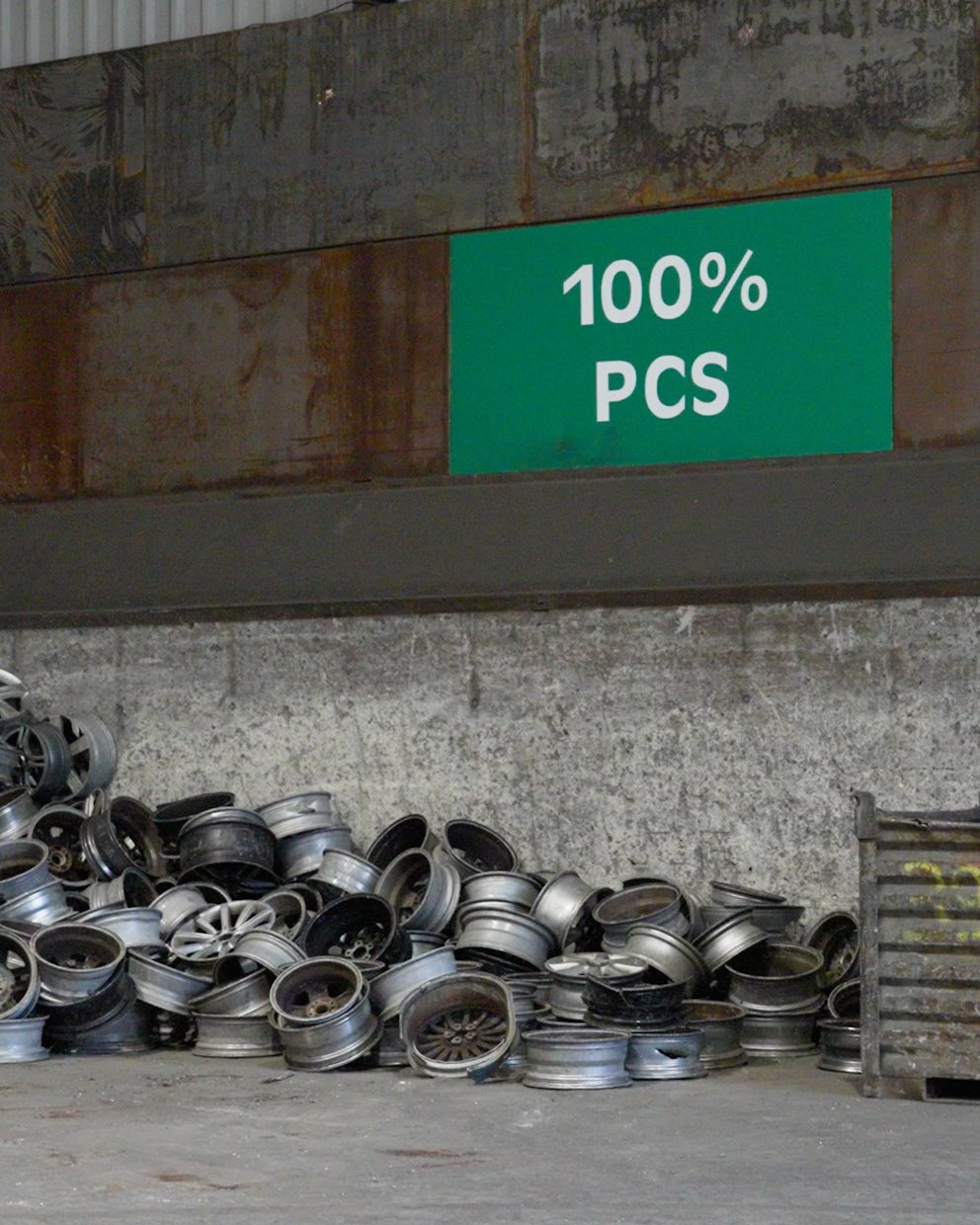
Post-consumer scrap is different. It comes from products that have already been used, collected, sorted, and recovered. That can include aluminium from construction, automotive applications, packaging, and consumer goods. From a recycling perspective, it is an important resource, but it is also much more variable.

That variability is not a small detail. It is often the main reason why a high recycled-content target becomes difficult to realize in practice.
If the incoming scrap contains too much of a certain element for the alloy we want to produce, we cannot simply remove it during remelting. Aluminium recycling is highly efficient, but it does not give us a reset button for chemistry. When one or more elements exceed the target alloy limits, the usual way to bring the composition back into specification is to dilute the melt with primary aluminium, or with very pure material. If an element is too low, that can often be corrected by adding the relevant alloying element.
This is one of the most important things I try to explain in these discussions. The challenge is not whether aluminium can be recycled. It absolutely can. The challenge is whether the recycled input available at that moment can still meet the requirements of the alloy and the product.
Why 100% recycled claims deserve a closer look
Because recycled content is such a visible sustainability metric, it is also one that can be oversimplified.
When I come across a claim about 100% recycled aluminium, I always want to understand exactly what is being claimed. Is it describing the physical content of the product itself, or is it referring to an allocated share within a broader production system? Those are two different things.

In some cases, a supplier may use a mass-balance approach. Recycled input is introduced into a shared production flow, and the recycled share is then allocated to specific customer orders through accounting and traceability rules. Depending on the framework, that can be a valid method. But it is not the same as saying that each individual item physically contains 100% recycled material.
I do not think these approaches should automatically be treated as misleading, but they do need to be explained clearly. If a project team, architect, or public buyer is using recycled content as part of its decision-making, then transparency matters just as much as the number itself.
When 100% recycled can be technically possible
There are of course situations where aluminium products can be produced from 100% recycled input.
In my experience, the best chance of achieving that comes when the scrap flow is stable, well sorted, and carefully controlled, often within a closed or semi-closed loop. If the material is separated by alloy family, contamination is low, and the chemistry is consistent over time, then producing within specification becomes much more realistic.
That is a very different situation from relying on a broad, mixed scrap stream with variable composition. In that case, the process becomes less predictable, and the need for blending increases.
So yes, 100% recycled aluminium can be technically possible. But the conditions behind that result are important, and they should be part of the story.
What I focus on in practice
In Hydro, my starting point is not to chase the biggest headline number. It is to be precise about what the material needs to do, what the alloy needs to be, and what the scrap can realistically support.
That means looking closely at traceability, chemistry, and documentation. Where possible, recycled-content statements should be backed by credible evidence, such as environmental product declarations or third-party verification. Just as importantly, the alloy and product still need to comply with the relevant standards for the application.
I also put a lot of value on controlled recycling loops. The more stable and predictable the scrap stream is, the more confidently we can work with higher recycled content while still protecting performance and quality. And when the technical limits are real, I believe it is better to explain them plainly than to hide them behind vague claims.
When the assumptions are visible, the language is clear, and the numbers can be supported. That is what a good sustainability discussion looks like to me.
The takeaway I come back to
I think aluminium has a strong sustainability story, but it is strongest when we tell it honestly.

Netherlands. Designed by Schréder.
Recycling aluminium saves significant energy and keeps valuable material in use. That is real. At the same time, light poles are demanding products with specific alloy and performance requirements. That means recycled content is not just a question of ambition. It is also a question of chemistry, process control, and the quality of the available scrap.
So when someone asks me whether a light pole can be made from 100% recycled aluminium, my answer is not yes or no.
It is this: sometimes, under the right conditions, yes. But what matters more is understanding those conditions, being transparent about what is physically in the metal, and making sure the final product still performs exactly as it should.